
How it started
It started quietly, the way these things always do.
Funmi — my wife — began complaining of stomach pain that came and went. At first we blamed stress. She'd just changed jobs. New role, new pressure, long hours.
Then her periods changed. Heavier. Unpredictable. Some months arriving twice, some months barely arriving at all.
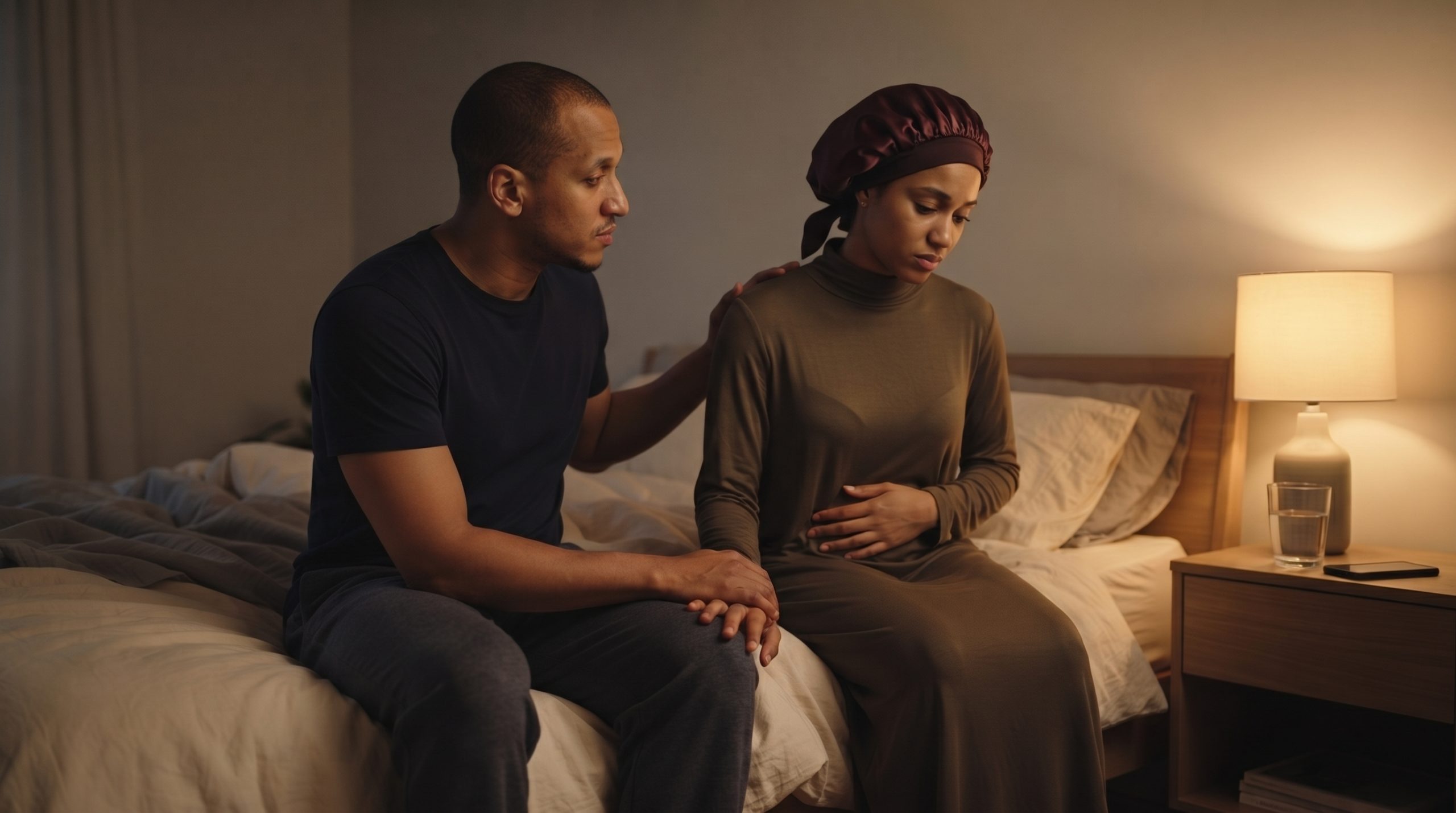
She stopped sleeping properly. I'd wake up at 2am and find her sitting up in bed, hand pressed against her stomach, jaw clenched, saying nothing.
What it cost us
I won't pretend it didn't affect us. It did.
Funmi grew quieter. She stopped going out with her friends as much. She'd cancel plans last minute, embarrassed to explain why.
I felt useless. I could see her hurting and I didn't know how to fix it. There were nights I'd hold her and feel her flinch, and I'd lie there afterward wondering what kind of husband can't protect his wife from her own body.
The appointment that changed everything
The scan came back. Fibroids. A cyst as well.
The doctor was kind, but direct. He mentioned surgery. He also mentioned, almost as an afterthought, that fibroids can return even after surgery.
Funmi didn't say a word in the car. When we got home, she sat on the edge of the bed and finally broke down. "Nobody tells you what to actually do," she said. "Before. During. After."
That sentence has stayed with me since.
A phone call to my aunt
I called my Aunty Nkechi that night, mostly just to talk to someone. She listened, and then she said something I didn't expect.
"Temidayo, have you asked grandma? Before all these hospitals, our women had their own ways. Go and ask her yourself."
I almost brushed it off. Then I thought — what did we have to lose?
Everything we had already tried
By this point we had tried a lot, and none of it had worked:
A herbal mixture from a market woman — no clear dosage, no explanation, just "drink this." Funmi took it for two weeks with no change.
A "fibroid tea" from an Instagram vendor — beautifully packaged, vague promises, and when we asked what was actually in it, no clear answer.
Pain medication — it dulled the ache for a few hours, but the moment it wore off, the pain came right back. It was managing a symptom, not the root problem.
Late-night Googling — every search left Funmi more anxious than before, not more informed. Forums full of conflicting opinions and worst-case stories.
Surgery — we seriously considered it, but froze at the cost, and at the fact that fibroids can grow back even after an operation. It felt like a huge risk for something that wasn't guaranteed to be permanent.
The visit to Ijebu-Ode
Two weekends later, we drove down to see Granny.
She's 82. I've known her my entire life and never once seen her fall sick. I wear glasses. She doesn't — not even at her age.
We sat with her on her veranda after Sunday service, the way we always do when we visit. I told her everything — the scan, the doctor's words, Funmi's sleepless nights.
Granny went quiet for a moment. Then she looked at Funmi directly and said, "My daughter, before doctors, we had our own way of caring for a woman's body. It is still here. It never left. It is only that nobody remembers to ask anymore."
The method revealed
She told us about a ritual her own mother had taught her — specific seeds, specific oils, a rhythm to follow, all things ordinary and easy to find, nothing exotic or expensive.
"That tea from your phone, that mixture from the roadside — they don't know your body. This is not a guess. This is something that has cared for our women in this family for longer than any hospital has existed."
She was blunt about it. "Stop chasing what you don't understand. Start with what your own blood has always known."
Skepticism
I'll be honest — I almost didn't take it seriously. It was stupidly simple. No fancy packaging, no big promises, just a quiet daily rhythm my grandmother wrote down for us on a torn sheet of paper.
Funmi was tired of trying things that didn't work, and I didn't blame her for being unconvinced.
The first days
We started anyway. The first few days, nothing seemed to change. Funmi stayed guarded, half-expecting another disappointment.
By day five, doubt was creeping back in for both of us.
The breakthrough
Then, around day eight, Funmi mentioned — almost in passing — that she'd slept through the whole night. No 2am waking. No hand pressed to her stomach.
A few days after that, she told me the ache that used to sit permanently in her lower stomach had gone quiet. Not fully gone. Just... quiet, in a way it hadn't been in months.
The real test
The real test came a month later, when she went back for her follow-up pelvic scan.
The radiologist asked her to come back and repeat the scan — more than once. I remember Funmi calling me from the hospital corridor, half-laughing, half-crying, saying "He keeps re-scanning me because he doesn't believe what he's seeing."
The cyst was gone. The fibroids had visibly reduced. By her third and fourth scans, there was no cyst at all, and the fibroids kept shrinking with each check.
We were so thankful to God, honestly. We couldn't stop telling people close to us about it.
Others at Granny's compound
What convinced me this wasn't a coincidence were the other women.
Granny's neighbour, a woman in her forties, mentioned she'd been quietly following a similar routine for her own heavy periods for years, and swore by it. A cousin who visited that same weekend later told us her own stomach pain had eased within the first two weeks of trying it.
None of them were selling anything. None of them had a reason to lie to me. That's what made me sit up.